Car Won’t Start in Regina? Jump Start vs Tow Explained
Quick Answer: If your car will not start in Regina, a jump start solves the problem about 70% of the time — the battery simply lost its charge due to cold weather, an interior light left on, or old age. However, if the engine cranks but will not fire, you hear grinding noises, smell fuel or burning, or the battery was already boosted recently, a tow is the safer choice. Forcing a jump start on certain failures can damage your alternator, starter, or electrical system.
⚡ Not sure which you need? Call us — our dispatcher will help you diagnose it over the phone.
Why So Many Cars Refuse to Start in Regina
You turn the key — or press the button — and nothing happens. Maybe a weak click. Maybe silence. Maybe the engine groans and quits. Whatever the symptom, a car that will not start ruins your morning instantly. In Regina, this is one of the most common roadside emergencies we respond to, and it happens far more often than most people expect.
The reason is simple: Saskatchewan’s extreme temperatures are brutal on batteries and starting systems. At −20°C, a fully charged battery delivers only about 50% of its normal cranking power. At −30°C, that drops even further — while your engine simultaneously needs more power to turn over cold, thick oil. The result is thousands of jump start calls across Regina every winter season.
But not every no-start situation is a dead battery. Sometimes the problem is deeper — a failed starter motor, a broken alternator, a fuel system issue, or electrical damage. Trying to jump start a car with one of these problems will not get you moving, and in some cases it can cause additional damage. That is why understanding the difference between a jump start situation and a tow situation is so important. Regina Towing handles both — 24 hours a day, 365 days a year.
When a Jump Start Will Get You Running Again
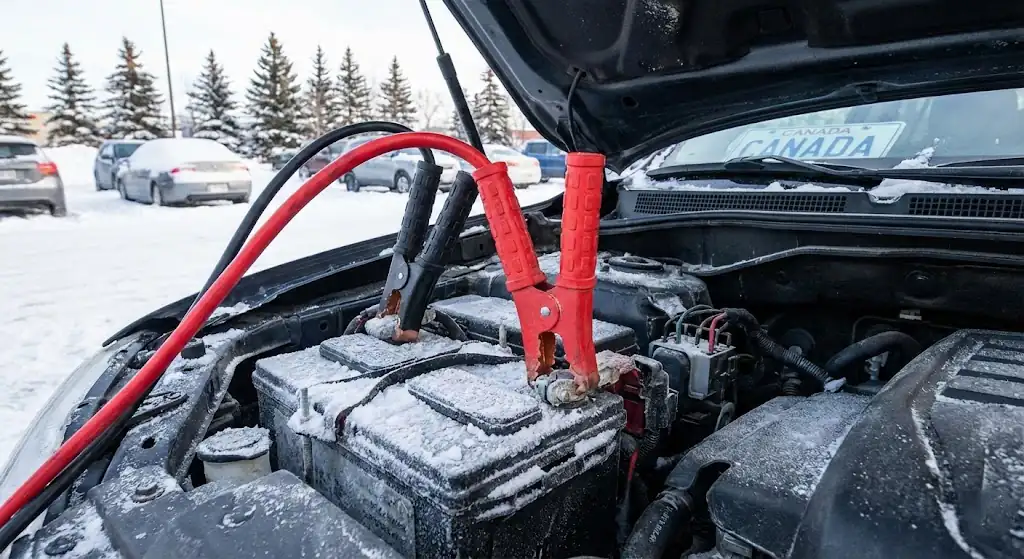
A car jump start works by using an external power source — either a portable booster pack or another vehicle’s battery — to provide the surge of electricity your engine needs to crank and fire. Once running, your alternator recharges the battery as you drive.
Here are the situations where a jump start is almost always the right fix:
- Dead battery from cold weather: By far the most common scenario in Regina. Your battery was fine yesterday, but overnight temperatures dropped below −15°C and drained its charge. A jump start restores enough power to fire the engine, and driving for 20+ minutes recharges it.
- Interior light or accessory left on: You accidentally left a dome light, headlight, or USB charger running overnight. The battery is drained but otherwise healthy.
- Vehicle sat unused for weeks: Batteries self-discharge over time. If your car sat parked for two weeks or more — especially in cold weather — a jump start service is usually all it needs.
- Short trips only: If you have only been driving very short distances (under 10 minutes), the alternator never fully recharges the battery. Over time the charge drops until it cannot start the engine.
- Old battery near end of life: Most car batteries last 3 to 5 years in Saskatchewan. As they age, cold cranking amps decline. A jump start gets you moving today, but replacement should happen soon.
💡 Pro Tip: After receiving a jump start in cold weather, drive for at least 20 to 30 minutes before shutting off the engine. This gives the alternator enough time to restore a meaningful charge to the battery. Stopping too soon may leave you needing a second jump.
When You Need a Tow Instead of a Jump Start
A battery jump start only solves one problem: a battery that lacks sufficient charge. If anything else in the starting chain has failed, a jump will not help — and attempting one repeatedly can cause real damage. Here are the clear signs you need a tow to a mechanic instead:
- Engine cranks normally but will not fire: The starter is turning the engine over — you can hear it grinding — but it refuses to catch and run. This usually points to a fuel delivery problem, ignition failure, or sensor issue. Jumping the battery will not help because the battery is not the problem.
- Loud clicking or grinding when you turn the key: A single heavy click often means a dead starter motor. Rapid clicking may indicate a battery so far gone that it cannot accept a jump charge safely.
- You smell fuel or burning: A strong gasoline smell can indicate a flooded engine or leaking fuel line. A burning smell may signal electrical damage. In both cases, do not attempt a jump — call for a 24-hour tow immediately.
- The jump start worked but the car dies again within minutes: This means the alternator is likely not charging the battery. Driving a car with a failing alternator will drain the new charge quickly and can leave you stranded in traffic.
- Dashboard warning lights are flashing erratically: Multiple warning lights, flickering gauges, or electrical malfunctions point to wiring or ECU issues that are beyond a roadside fix.
- You already tried a jump and it failed: If a professional-grade booster pack cannot revive the battery, the issue is not charge-related. Further jump attempts can overheat connections and damage sensitive electronics. Time for a flatbed tow.
⚠️ Safety Warning: Never attempt to jump start a battery that appears swollen, cracked, leaking acid, or is emitting a rotten-egg smell (hydrogen sulphide). A damaged battery can explode when exposed to a charging current. If you see any of these signs, stay away from the battery, ventilate the area, and call for a tow immediately.
Jump Start vs Tow: Quick Comparison Chart
Use this table to quickly determine which service your situation requires:
How Our Car Jump Start Service Works in Regina
When you call (639) 477-9924 for a car jump start service in Regina, here is exactly what happens:
Phone diagnosis. Our dispatcher asks what happens when you try to start the car. Based on your description, we determine whether a jump start or tow is the right call — saving you time and money.
Quick dispatch. A technician is sent to your GPS location with a commercial-grade booster pack and full diagnostic equipment. You receive an ETA by text.
Battery inspection. Before connecting cables, the technician inspects your battery for swelling, corrosion, cracks, or leaks. Unsafe batteries are not jumped — they are flagged for replacement.
Professional jump start. Using proper polarity connection (positive-to-positive, negative-to-ground), we deliver a controlled charge. The engine starts, and the technician verifies stable idle voltage.
Advice before you leave. We tell you how long to drive for a full recharge, whether your battery should be tested or replaced soon, and what to watch for. If the jump fails, we switch to tow mode immediately — no second call needed.
6 Reasons Your Car Won’t Start (Besides a Dead Battery)
Most drivers assume a no-start means dead battery, but there are several other culprits — especially in Regina’s harsh climate. If a jump start does not solve the problem, one of these is likely responsible:
1. Failed starter motor. The starter is the electric motor that physically cranks your engine. When it fails, you typically hear a single loud click or a grinding noise. Starters are especially vulnerable in cold weather when they must work harder against thick oil. A jump start will not fix a dead starter — you need a tow to a mechanic.
2. Dying alternator. Your alternator recharges the battery while the engine runs. If it fails, the battery drains and the car dies — often while you are driving. A jump start may get the engine running temporarily, but the car will stall again within minutes. This is a tow-to-shop situation.
3. Fuel delivery failure. A failed fuel pump, clogged fuel filter, or frozen fuel line (common in Saskatchewan winters if there is moisture in the tank) prevents gasoline from reaching the engine. The starter cranks fine, but the engine will not fire. A jump start does nothing for this problem.
4. Ignition system failure. Worn spark plugs, a failed ignition coil, or a broken crankshaft position sensor can all prevent the engine from starting. Electrical systems become more fragile in extreme cold.
5. Corroded battery terminals. Heavy white or green buildup on battery terminals blocks the flow of electricity even from a good battery. Sometimes cleaning the terminals on-site fixes it. Our technician checks this before jumping.
6. Security system lockout. Some vehicles interpret repeated failed start attempts as theft and lock out the ignition. A jump start will not override this — the system needs to be reset. Check your owner’s manual or call your dealership.
Car Won’t Start? We’ll Diagnose It Over the Phone.
Jump start or tow — we send the right service the first time. Available 24/7 across Regina.
DIY Jump Start vs Professional Service: What’s Safer?
If a friend or neighbour offers to jump your car with their vehicle, it might work — but there are genuine risks, especially with modern vehicles that have sensitive electronics. Here is how the two options compare:
We are not saying a DIY jump never works — it absolutely does in straightforward situations. But in extreme cold, with modern vehicles, or when you are on a highway shoulder, a professional car jump start service is the safer, faster option. Our battery boost service is designed specifically for these situations.
Why Saskatchewan Cold Kills Car Batteries So Fast
Regina regularly sees temperatures of −25°C to −35°C during January and February. These temperatures affect batteries in two ways simultaneously:
Chemical reactions slow down. A lead-acid battery generates electricity through a chemical reaction between lead plates and sulphuric acid. Cold temperatures slow this reaction dramatically. At −20°C, a fully charged battery can deliver only about 50% of its rated cold cranking amps (CCA). At −30°C, that drops to roughly 35%. Natural Resources Canada confirms that cold weather is the leading cause of battery failure in Canadian vehicles.
Engine demand increases. Cold makes engine oil thicker, which means the starter motor needs more power to crank the engine. So your battery produces less power at the exact moment your engine demands more. This mismatch is why cold-morning no-starts are so common in Saskatchewan. Plugging in your block heater below −15°C helps significantly — it keeps the engine oil warm and reduces the cranking load. Learn more in our winter vehicle preparation guide.
How Long Do Car Batteries Last in Regina?
In mild climates, a car battery can last 5 to 7 years. In Saskatchewan, expect 3 to 4 years at best. The repeated cycling between extreme heat in summer (which accelerates internal corrosion) and extreme cold in winter (which strains the chemical reaction) shortens battery life significantly.
If your battery is 3+ years old and you needed a jump start this winter, take it to any auto parts store for a free load test. They can tell you exactly how much cranking capacity remains. Replacing a weak battery proactively costs far less than emergency roadside calls, tow bills, or being stranded in −30°C weather.
💡 Pro Tip: When buying a replacement battery in Regina, choose one with the highest CCA (cold cranking amps) rating that fits your vehicle. Look for at least 700 CCA for cars and 850+ CCA for trucks and SUVs. This provides a critical buffer for our −30°C mornings.
Where We Provide Jump Start Service Across Regina
Our technicians respond to jump start calls in every Regina neighbourhood and nearby areas, including:
- Downtown Regina — Parkades, office lots, street parking
- Albert Park — Residential driveways, mall parking
- University Park — Campus lots and residential streets
- Normanview — Rochdale corridor, retail and residential zones
- Glencairn, Lakeview, River Heights — Residential areas across the city
- Ring Road, Highway 1, and rural roads within the greater Regina area
View our full service area to confirm coverage in your neighbourhood.
5 Ways to Prevent a Dead Battery in Regina
1. Plug in your block heater below −15°C. A block heater keeps the engine and oil warm, dramatically reducing the cranking power your battery needs. The Saskatchewan driver’s handbook recommends plugging in whenever temperatures drop below −15°C.
2. Replace your battery every 3–4 years. Do not wait for a failure. Proactive replacement before the third winter is the most reliable way to avoid morning no-starts in Regina’s climate.
3. Clean terminal corrosion annually. White or green buildup on battery terminals increases resistance and reduces available cranking power. A wire brush and terminal cleaner solve it in five minutes.
4. Drive for at least 20 minutes regularly. Short trips never give the alternator time to recharge the battery fully. If your daily commute is under 10 minutes, take a longer drive once a week.
5. Turn everything off before shutting down. Make sure headlights, cabin lights, USB chargers, heated seats, and the stereo are all off before you turn the key. Even small parasitic drains add up overnight in cold weather.
Related Roadside Services in Regina
A dead battery often coincides with other problems — locked keys, flat tires, or an empty tank. We handle everything from one call through our full roadside assistance service:
- Car unlocking — Locked your keys in while checking under the hood? We open the door safely.
- Tire change — Discovered a flat tire alongside a dead battery? We fix both on-site.
- Fuel delivery — Ran out of gas while dealing with electrical issues? We bring fuel to you.
- Winch-out recovery — Battery died after you slid into a snowbank? We pull you free and boost.
- 24-hour towing — If the car needs a mechanic, we tow day or night.
Frequently Asked Questions About Jump Starts in Regina
How much does a jump start cost in Regina?
The cost varies depending on your location, time of day, and whether additional services are needed. We provide a clear price quote over the phone before dispatching so there are no surprises. Call (639) 477-9924 for an instant estimate.
How fast can you get to me for a car jump start in Regina?
Typical response time is 20 to 40 minutes. During extreme cold snaps when call volume is high, wait times may be slightly longer. We always send your ETA by text immediately after dispatching.
Can a jump start damage my car’s electronics?
A properly performed jump start with correct polarity and surge-protected equipment is safe for modern vehicles. The risk comes from reversed cables or consumer-grade boosters without surge protection — which is why professional service is recommended for newer cars with sensitive computer systems.
What if the jump start does not work?
If a professional-grade jump cannot revive your vehicle, the problem is likely a failed starter, alternator, or ignition component. Our technician can switch to tow service immediately without you needing to call a separate company. We transport your vehicle to a mechanic of your choice.
How long should I drive after a jump start to recharge the battery?
Drive for at least 20 to 30 minutes at normal speeds. Highway driving is best because the alternator runs faster and charges the battery more efficiently. Avoid shutting the engine off and restarting during this recharge window.
Is your jump start service available at 3 AM or during blizzards?
Yes. We operate 24 hours a day, 365 days a year, including extreme weather conditions, statutory holidays, and overnight hours. Dead batteries are most common during cold overnight periods, and our team is staffed accordingly.
Do I need a CAA membership for a jump start in Regina?
No. Our jump start service requires no membership or subscription. Call when you need help, get a quote, and pay only for the service performed. CAA members are welcome to use us too — especially when CAA wait times during cold snaps exceed an hour.
Can you jump start a diesel truck in Regina?
Diesel engines require higher cranking amps than gasoline vehicles. Our commercial-grade booster equipment is rated for both gas and diesel passenger vehicles. For larger commercial diesel trucks and equipment, our heavy-duty towing team has the equipment required.
Should I replace my battery after needing a jump start?
Not necessarily. If your battery is under 3 years old and the dead charge was caused by leaving a light on or extreme cold, a single jump start is normal. However, if your battery is 3+ years old or you have needed multiple jumps in one season, replacement is strongly recommended before the next cold snap.
Can you jump start a hybrid or electric vehicle?
Hybrid vehicles have a small 12V battery that can be jump-started just like a conventional car. Fully electric vehicles (EVs) also use a 12V auxiliary battery for systems like door locks and the onboard computer — this can often be boosted. However, the main traction battery in an EV cannot be jump-started. If you are unsure, our dispatcher can advise you on the phone.
Dead Battery? Don’t Guess — Call Regina Towing
We diagnose over the phone and send the right service — jump start or tow — the first time.
24/7 across Regina. No membership. Transparent pricing.