Accident Towing Regina: What Happens After a Collision
A collision is stressful, loud, and confusing. In seconds you are dealing with damaged vehicles, flashing lights, worried passengers, and questions from police and other drivers. On top of that, you still have to figure out how your vehicle will be safely removed from the scene and where it should go next for repairs or assessment .
Accident towing in Regina is different from a normal breakdown tow. It involves police coordination, insurance requirements, scene safety, and often direct billing between the towing company and your insurer . Understanding how accident towing works before you need it helps you stay calm and make better decisions after a collision .
First Steps Right After a Collision
Before thinking about towing, you need to make sure everyone is safe and the scene is secure . The basic steps are:
- Check for injuries: If anyone is hurt, call 911 immediately and request medical help .
- Move to safety if possible: If vehicles are drivable and there are no serious injuries, move them to the shoulder or a safe nearby area to avoid blocking traffic .
- Turn on hazard lights: Make your vehicle as visible as possible to other drivers .
- Set out warning devices: If you have triangles or flares and it is safe, place them behind your vehicle .
- Call the police: For injuries, significant damage, hit-and-run, or impaired driving suspicions, police attendance is typically required .
Once emergency needs and safety are addressed, you can start thinking about accident towing, collision recovery, and where your vehicle should go next .
For detailed guidance on staying safe at the scene, read our article on what to do while waiting for a tow truck .
How Police and Accident Towing Work Together
In Regina, police may attend the scene depending on the severity of the collision, traffic impact, and whether there are injuries or disputes . Their main roles are to secure the scene, direct traffic, collect information, and determine whether vehicles need to be removed immediately for safety .
Key things to know about police and towing :
- Police can request that damaged vehicles be moved quickly if they are blocking lanes or creating a hazard .
- In some cases, police may suggest or call a local towing provider if you do not have a preference .
- You typically have the right to choose your towing company and the destination of your vehicle unless police must clear the scene urgently .
- If your vehicle is undriveable, you can tell the officer which towing company you’ve contacted and where you want the vehicle taken (collision centre, your home, a storage yard, or a shop of your choice) .
It helps to keep the number of a trusted Regina towing company saved in your phone so you can quickly request accident towing yourself instead of having someone chosen for you by default .
When You Need Accident Towing (Not Just Roadside Help)
Not every incident requires dedicated accident towing. Sometimes a vehicle can be safely driven away or handled with basic roadside assistance like a tire change or battery boost . You likely need accident towing when :
- Your vehicle is not drivable (fluids leaking, wheels bent, severe body damage) .
- Airbags have deployed and the vehicle cannot be safely driven .
- The frame, suspension, or steering appears damaged .
- It is unsafe to drive due to broken lights, missing bumpers, or severe alignment issues .
- Police or your insurance provider advise towing rather than driving .
If you’re unsure, err on the side of safety. Driving a damaged vehicle can cause more harm and even affect insurance coverage if it leads to further damage or another incident .
What Happens When You Call an Accident Towing Company
When you call for accident towing in Regina, the dispatcher will ask for detailed information so they can send the right truck and prepare for insurance and storage needs . Be ready to provide:
- Your name and contact information .
- Exact location of the collision (intersection, highway marker, or nearby landmark) .
- Vehicle make, model, color, and license plate .
- Whether the vehicle is drivable or severely damaged .
- Whether police and/or paramedics are on scene .
- Where you want the vehicle to be taken (body shop, your home, storage yard, dealership) .
Dispatch will then send the nearest available truck—often a flatbed for accident-damaged vehicles—and give you an estimated arrival time . During busy times or bad weather, response may be slightly longer, but accident calls are typically prioritized due to safety and traffic concerns .
What to Expect When the Tow Truck Arrives
Once the tow operator arrives on scene, they will focus on safety first and then the safe loading of your vehicle . Here’s what usually happens:
- The operator parks in a safe position and activates lights for visibility .
- They assess the damage and determine the best way to load the vehicle (flatbed winch, wheel-lift, or special equipment) .
- They may speak with police to coordinate lane closures or traffic control as needed .
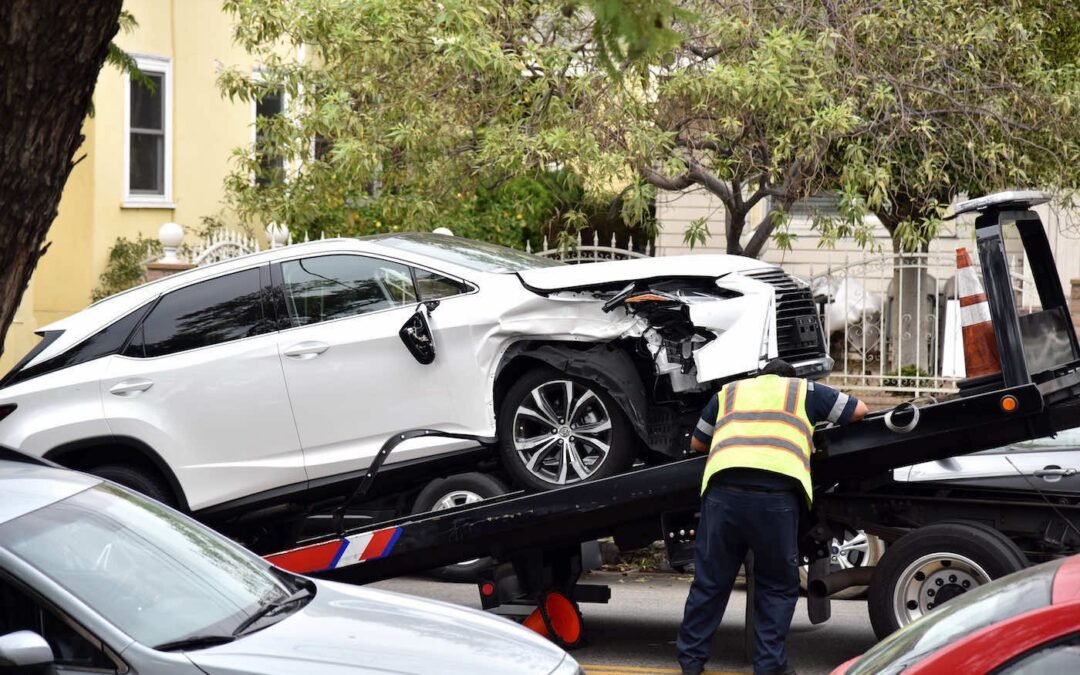
- Your vehicle is carefully winched or loaded, taking care not to cause additional damage .
- The operator will confirm the tow destination with you and explain any next steps .
If personal items are accessible and it is safe, you should remove valuables, documents, and anything you’ll need in the next few days (work items, medication, child seats, garage door opener, etc.) before the vehicle is taken away .
Insurance-Approved Towing and Direct Billing
One of the biggest questions after a collision is: “Who pays for the tow?” In many cases, your auto insurance policy includes coverage for accident towing and storage as part of collision or comprehensive coverage .
Insurance-Approved Towing
Insurance-approved towing means the towing provider meets the insurer’s requirements for licensing, documentation, and rates . Often, your insurer or adjuster may recommend or authorize a specific company, but you can usually choose your own as long as they meet normal professional standards .
Benefits of using an insurance-approved provider include :
- Smoother claims process with proper documentation and invoices .
- Familiarity with local body shops, dealerships, and collision centres .
- Understanding of insurer procedures and what information they need .
Learn more about insurance coordination in our detailed guide to insurance-approved accident towing in Regina .
Direct Billing to Insurance
Many accident towing companies in Regina can bill your insurance provider directly for towing and sometimes storage . This means:
- You are not required to pay the full towing bill up front (depending on coverage and insurer rules) .
- Invoices and photos are sent straight to the insurance company .
- You focus on your claim and repairs instead of reimbursement paperwork .
Always keep your insurance information handy—policy number, company name, and claims phone number—so the towing provider can note it immediately . If you’ve already opened a claim, provide the claim number as well .
Where Your Vehicle Can Be Taken After an Accident
After a collision, you usually have several choices about where your vehicle should go . Common options include:
- Directly to a body shop or collision centre: Ideal if you already know where you want repairs done .
- To a dealership: Often preferred for newer vehicles or warranty-related repairs .
- To a towing company’s secure storage yard: Useful if your vehicle’s status is unclear or you haven’t chosen a repair shop yet .
- To your home or private property: Sometimes chosen for minor damage or when you plan to decide later .
Your insurance provider may have a network of preferred repair shops, but you generally have the right to choose where your vehicle is repaired . If you haven’t decided yet, short-term storage in a secure yard gives you time to speak with your adjuster and compare options .
Vehicle Storage After a Collision
If your vehicle cannot go directly to a repair facility, it is usually stored in a secure compound or yard . Important points about storage:
- Storage fees are usually charged per day .
- Insurance may cover reasonable storage costs as part of your claim, especially when you act promptly .
- You or your insurer can later authorize a secondary tow from the storage yard to a chosen repair shop .
- You may need photo ID and proof of ownership to access the vehicle or remove items .
It is wise to speak with your insurer as soon as possible after the accident . Prolonged storage without a plan can increase costs, so clear communication with your adjuster helps avoid unnecessary days in the yard .
Accident Towing vs. Regular Towing
Accident towing has several key differences from standard breakdown towing . Here’s a quick comparison:
| Situation | Accident Towing | Regular Towing |
|---|---|---|
| Reason for Tow | Collision, impact, or major damage | Mechanical breakdown, flat tire, dead battery |
| Scene Conditions | Debris, traffic hazards, police presence | Generally calm roadside or parking lot |
| Vehicle Condition | Damaged body/frame, airbags deployed, leaking fluids | Intact, but not drivable |
| Coordination | Police, insurance, possibly multiple parties | Primarily between driver and tow company |
| Destination | Body shop, storage yard, dealership, or home | Repair shop, home, or preferred mechanic |
| Billing | Often through insurance or direct billing | Usually paid by driver at time of service |
Because of these differences, accident towing requires additional care, documentation, and communication between everyone involved .
What You Should Do (and Avoid) at the Scene
After a collision, small decisions can impact your safety and your claim . Keep these best practices in mind:
Do:
- Take photos of the scene, vehicle positions, and damage from multiple angles .
- Exchange names, contact details, and insurance information with other drivers .
- Get names and contact information of any witnesses .
- Note the badge number of responding officers if applicable .
- Ask where your vehicle is being taken if someone else arranged the tow .
Avoid:
- Admitting fault or arguing about blame at the scene .
- Signing anything you do not understand, except what is required by police .
- Leaving the scene before police allow it in more serious collisions .
- Attempting to drive a vehicle that is clearly unsafe or leaking fluids .
If you feel overwhelmed, remember that you can always ask the tow operator or officer to explain what is happening and where your vehicle is going .
Accident Towing Coverage Across Regina
Professional accident towing services operate 24/7 throughout Regina and surrounding areas , including:
- Ring Road and Highway 1 corridors
- Downtown Regina intersections and business districts
- Residential areas including Lakeview, Glencairn, Albert Park, and Normanview
- Shopping centres like Cornwall Centre and Southland Mall
- Industrial zones and commercial areas
- Rural highways within service radius
Check our complete service area coverage to confirm availability in your specific location .
Winter Accident Towing Considerations
Regina winters create additional challenges for accident recovery . Ice, snow, and freezing temperatures mean:
- Accident scenes may be slippery and harder to secure safely .
- Vehicle loading requires extra care to prevent sliding or additional damage .
- Response times may be slightly longer during major storms .
- Flatbed towing is often preferred to keep damaged vehicles completely off icy roads .
For more about winter driving challenges, see our article on how Regina’s winters affect your car and how towing can help .
Related Emergency Services
In addition to accident towing, Regina towing companies provide comprehensive emergency services :
- 24/7 roadside assistance for non-accident emergencies
- Winch-out service for vehicles stuck in snow, ice, or ditches
- Flatbed towing for damaged or specialty vehicles
- Heavy-duty towing for commercial vehicles and large trucks
- Long distance towing to repair facilities across Saskatchewan
Frequently Asked Questions About Accident Towing in Regina
Do I have to use the towing company the police call?
In most cases, you can choose your preferred towing company if it can arrive in a reasonable time and does not delay clearing a dangerous scene . If you do not have a preference or cannot decide, police may call a local company from a rotation or list to remove vehicles quickly .
Who decides where my car is towed after an accident?
Unless your vehicle must be moved immediately for safety or law enforcement reasons, you typically choose the destination: a collision centre, dealership, your home, or a storage yard . Your insurer may recommend a network repair shop, but the final decision is usually yours .
Will my insurance cover the cost of accident towing?
If you have collision or comprehensive coverage, accident towing is often included, subject to your policy limits and deductibles . It is important to report the collision to your insurer as soon as possible and provide towing invoices or details so they can confirm coverage and handle payment or reimbursement .
Can I go with the tow truck driver from the scene?
In many cases, one passenger can ride in the tow truck cab from the scene to the destination, but this can depend on company policy, seat availability, and safety rules . If you have multiple passengers, you may need someone else to pick you up or arrange alternate transportation .
What if my car is a total loss?
If your insurer declares the vehicle a total loss, it will typically remain at a storage yard or repair facility while the claim is settled . Once the payout is arranged, the insurance company usually handles disposal or salvage and may move the vehicle again if needed . Keep in close contact with your adjuster so storage time is not unnecessarily extended .
What if I need a tow but no one was injured and damage seems minor?
You can still arrange accident towing even for minor collisions if the vehicle is not safe to drive . Sometimes damage that looks minor can affect alignment, steering, or essential systems . If in doubt, have the vehicle towed to a shop for inspection rather than driving it and risking further damage .
Can I change my mind about the repair shop after the car has been towed?
Yes, but it may require a second tow . If your vehicle was first towed to a storage yard or one shop and you later choose a different repair facility, your insurer may authorize an additional tow as part of the claim . Always confirm with your adjuster before arranging another move .
Get Professional Accident Towing in Regina
Collisions are never convenient, but knowing how accident towing works in Regina makes the process less overwhelming . From the first moments at the scene to choosing a repair shop and dealing with insurance, having a trusted towing company and a basic understanding of the process puts you back in control .
Our accident towing services include:
- 24/7 emergency response throughout Regina
- Direct billing to most major insurance providers
- Safe vehicle recovery using flatbed trucks and specialized equipment
- Police coordination and scene safety management
- Secure storage facilities
- Transport to body shops, dealerships, or your chosen location
- Professional documentation for insurance claims
Save our number in your phone today so you’re not searching under stress later. When a collision happens, one call can handle safe removal of your vehicle, coordination with police and insurance, secure storage, and delivery to the right repair facility .
For comprehensive towing services including roadside assistance, breakdown towing, and heavy-duty towing, Regina’s trusted professionals are here to help 24/7.
Involved in a collision in Regina? Call (639) 477-9924 for accident towing, safe recovery, and help coordinating with your insurance.
Note: All prices mentioned in this article are provided for general reference and informational purposes only. These prices are not fixed and may vary depending on facts, market conditions, location, time, availability, or other relevant factors. Actual prices may change without prior notice. Readers are advised to verify details independently before making any decisions.